Hello! Recently I visited two great exhibits about the Maya. I am showcasing one of the exhibits in this post.
The first place I visited is the Museum of Fine Arts in Boston. They have galleries for Ancient Mesoamerica art that are part of their broader “Art of the Americas Wing,” which spans 3,000 years of art from across North, Central, and South America and the Caribbean. ancient Americas. The MFA has been at the forefront of presenting pre-Columbian artifacts as part of art history, rather than solely in an anthropological context. The MFA is particularly strong in Classic Maya earthenware.
So as you approach the door of the Ancient Americas you are greeted by these:

These are BURIAL URNS OF THE KICHÉ MAYA
Large burial urns like these are unique to the K’iché Maya of Guatemala’s southern high-lands, and nearly all date to the two centuries between AD 650 and 850. These urns held the remains of important people and were buried in pyramids or placed in sacred caves, where descendants made offerings and sought advice from their revered ancestors.
They are quite large as they would contain the remains of important individuals, either as tightly wrapped bundles or as secondary burials of collected bones. The K’iche’ Maya, like other Mesoamerican cultures, viewed death not as an end but as a transition to another realm, particularly the watery Underworld (Xibalba). These urns served as a conduit, facilitating the deceased’s journey and allowing the living to communicate with their deified ancestors.
The presence of carbon traces on some urns indicates they came into contact with fire, likely as part of burial or cache rituals. Offerings to the dead would have been made through openings in the lids, further emphasizing the ongoing interaction between the living and the deceased. Imagine that!
Iconography and Symbolism: The K’iche’ Maya burial urns are richly adorned with symbolic imagery that reflects their cosmology and beliefs about regeneration and rebirth. Key themes and motifs include:
Maize God: A very common and significant figure on these urns is the Maize God. His presence symbolizes life after death, mirroring the cyclical nature of maize: it dies in the harvest only to sprout anew each spring. This metaphor of death, burial (planting), and resurrection was central to Maya beliefs about human life and the afterlife. You might see him with a maize cob, or a maize stalk emerging from his loincloth.
The museum description was: The Maize god on the lid symbolizes life after death, as the appearance of maize in the fields each spring was the Maya metaphor for the resurrection of the human soul:

Maya Late Classic Period A.D. 650–850
Object Place: Guatemala, Southern Highlands
Underworld Deities and Creatures: The urns often feature figures associated with the Underworld. For example, some lids depict the Maize God sitting atop a shark-like head with an open maw, representing the entrance to the watery Underworld. An aged supernatural being might also peer out from this netherworld realm.
Jaguars: Jaguars are frequently depicted, sometimes in playful or comical ways, or as frontal deity faces or masks. The jaguar was a powerful creature in Mesoamerican cosmology, often associated with the night, the underworld, and rulers. The MFA’s collection includes an urn base with a modeled and painted jaguar head and a body imitating jaguar pelt.
The museum description was: The lid of this burial or cache urn is embellished with the uppor torso of a jaguar. The scarf around his shoulders identifies him as a specific supernatural jaguar being associated with the underworld and sacrifice. The feline’s proper right arm is raised and his claws are opened in a menacing gesture.
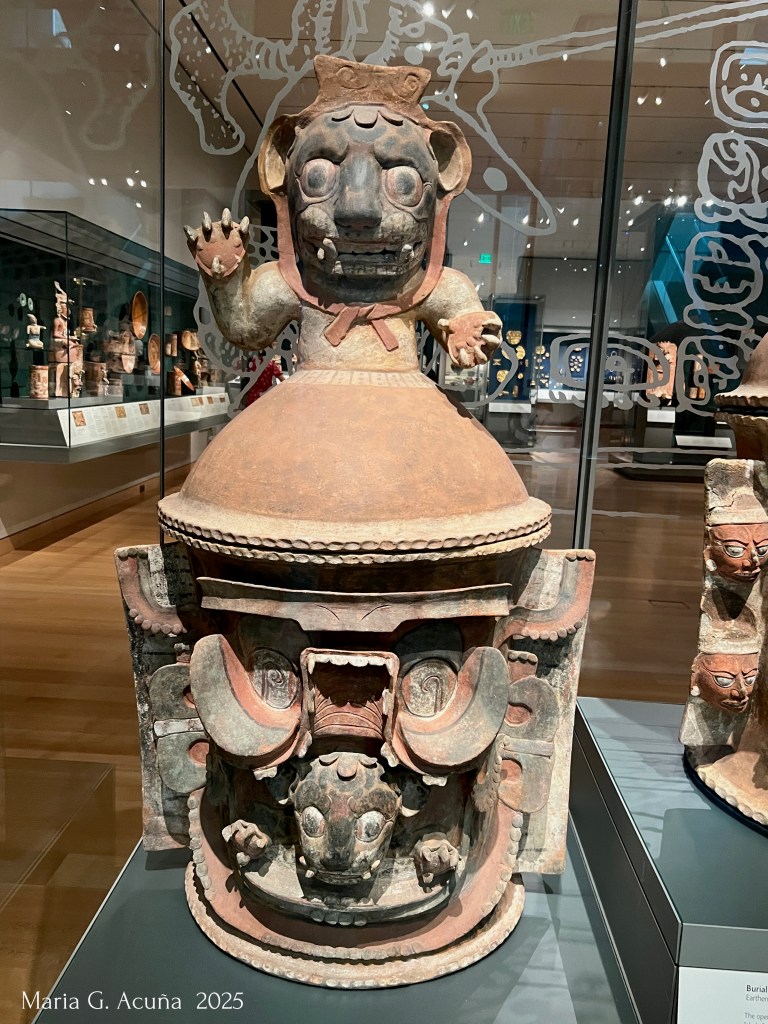
Maya. Late Classic Period A.D. 650–850
Object Place: Southern Highlands, Guatemala
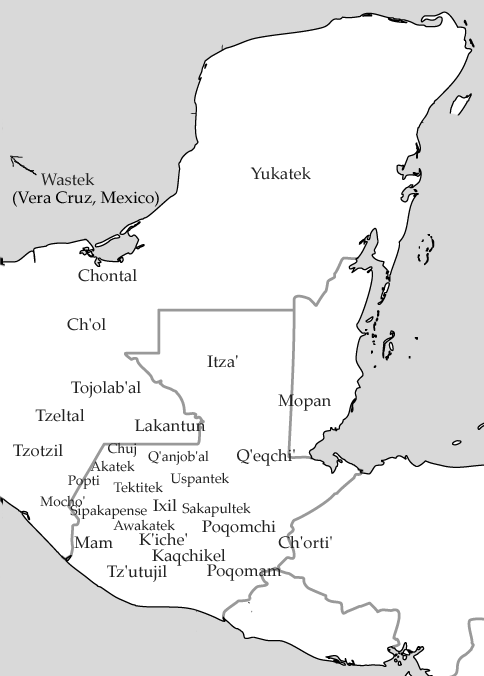
Looking at the name K’iche’ Maya, it made me wonder about how many kind of Maya there were. I found this great general description in the museum:
THE MAYA
The Maya live in the volcanic highlands and tropical lowlands of what are now southern Mexico, Guatemala, Belize, and parts of Honduras and El Salvador. Even when at their most powerful, in the centuries between AD 400 and 800, the Maya were not an empire. Instead, they formed confederations of towns and cities, much like European royal city-states, which competed for supremacy.
Towns were dotted with palaces and pyramids topped by richly decorated temples, some of which survive today. Maya civilization reached its peak between AD 550 and 850 (the “late classic” period), when artists produced extraordinary paintings on pottery that reveal the complexity of Maya life, politics, and religion. Monumental stone carvings portray rulers, and hieroglyphic texts extol their accomplishments.

And one way they are classified is by their languages. So K’iche’ Maya speak… K’iche’! It is also know as Quiché (In Spanish). It’s the second most widely spoken language in Guatemala, after Spanish, with over a million speakers! Yes! They are still with us! K’iche’ has a rich literary tradition, including the Popol Vuh, a sacred text of the Ancient Maya.
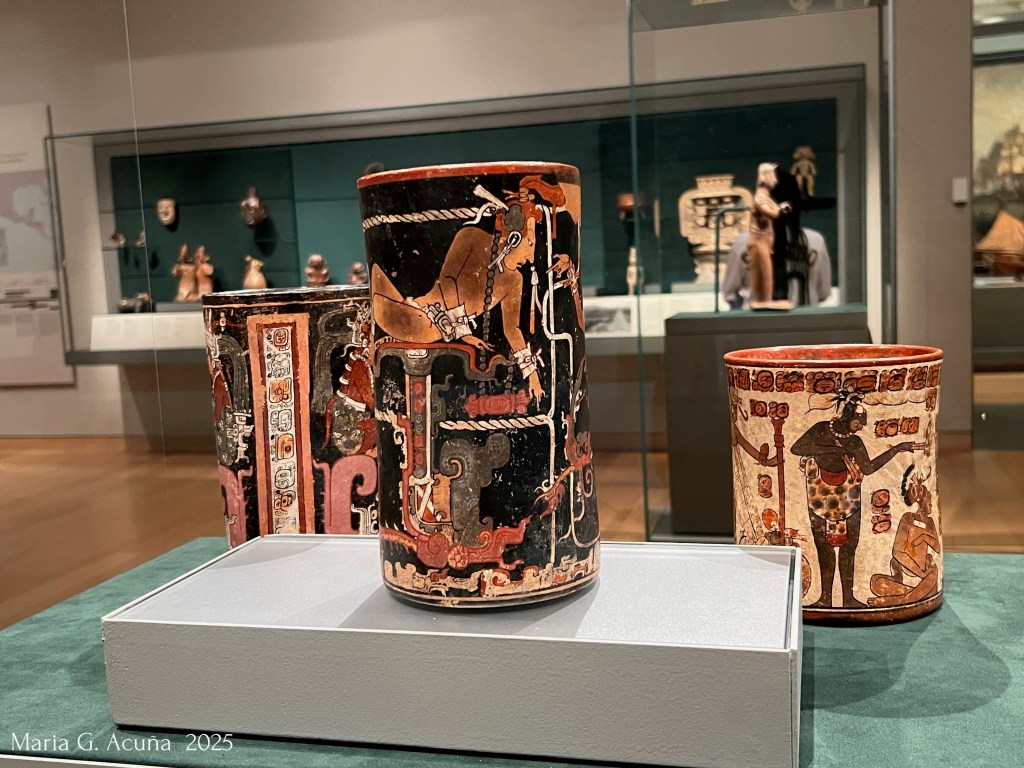
Apart from these incredible urns, the MFA also has an impressive collection of earthenware including cylinder vases (often with hieroglyphic texts). These were fascinating to me because of their intricate paintings.
1. Cylinder vase Maya Late Classic Period A.D. 755–780
Place of Manufacture: Motul de San José area, El Petén, Guatemala
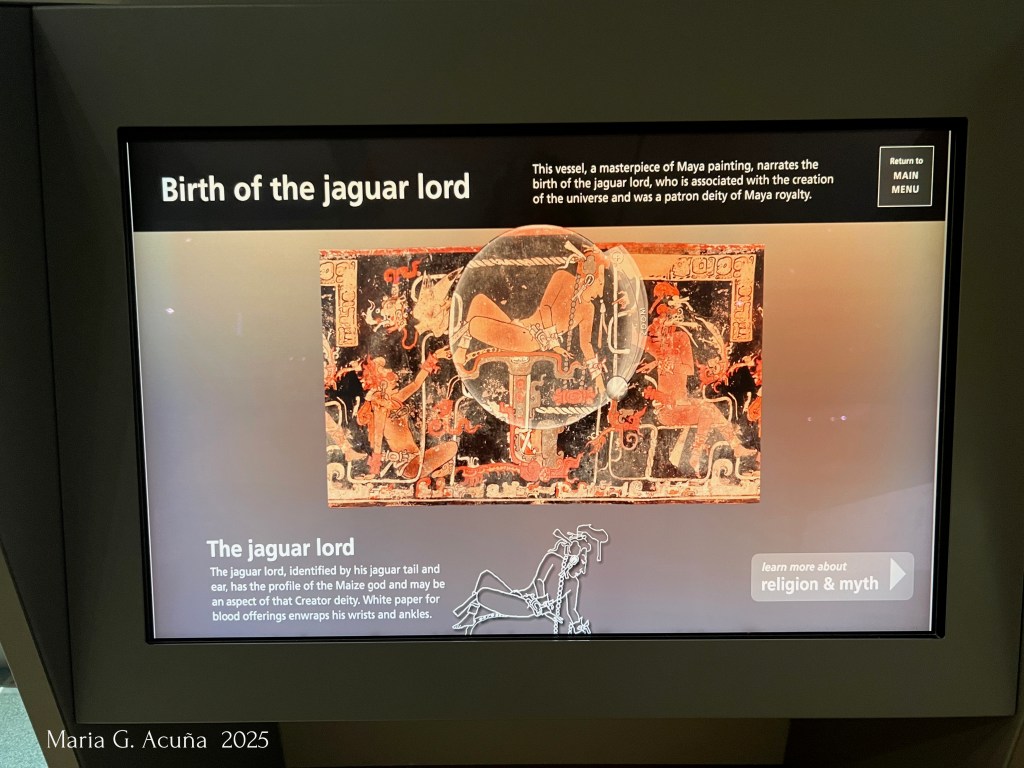
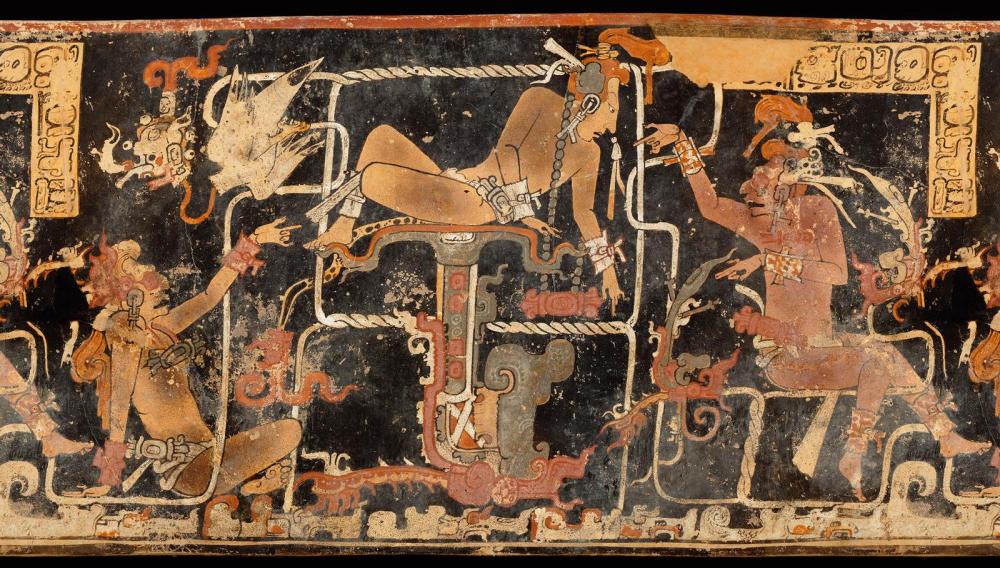
They also had a great way to see the entire piece in flat with its meaning:
And I found this longer description in the museum’s website:
This vase is considered one of the finest examples of Maya painting. The artist’s mastery of the watercolor-like quality of slip paint is particularly remarkable here. Notice the subtle washes on the bodies, extremely difficult to achieve with clay-based paints.
The scene depicts the birth of the Maize god, flanked by a supernatural with jaguar attributes and another with Sun-god features. The white umbilical cord that unifies the scene also encouraged the viewer to rotate the vase. The hieroglyphic text records the birth’s mythological date and supernatural locale, Na-Ho-Chan (Five Sky House).
They also had this description about the artist who made this vase:
A MASTER ARTIST
The three largest vases here are the work of one of the finest Maya artists, who likely painted them for an 8th-century ruler in Guatemala named K’inich Lamaw Ek’. We don’t know the artist’s name, but his/her creations are recognizable for their dramatic imagery, rich colors, and unsurpassed mastery of clay paint (called “slip”), which is unforgiving of errors.
The hieroglyphic texts on pottery identify K’inich Lamaw Ek’ as the ruler of the Ik’ polity from around AD 768-779, whose capital was at the archaeological site of Motul de San José. Chemical analysis of the vessels’ clay indicates they were made in the vicinity of the capital.
I think it is so great that they were able to appreciate and highlight the work of this Maya artist even if we don’t know their name. And I’m also totally creeped out by the umbilical cord wrapping all around the vase!
2. Cylinder vase. Maya Late Classic Period A.D. 740–780 (Baby Jaguar) Place of Manufacture: El Petén, Guatemala, Motul de San José area, Lake Petén Itzá region
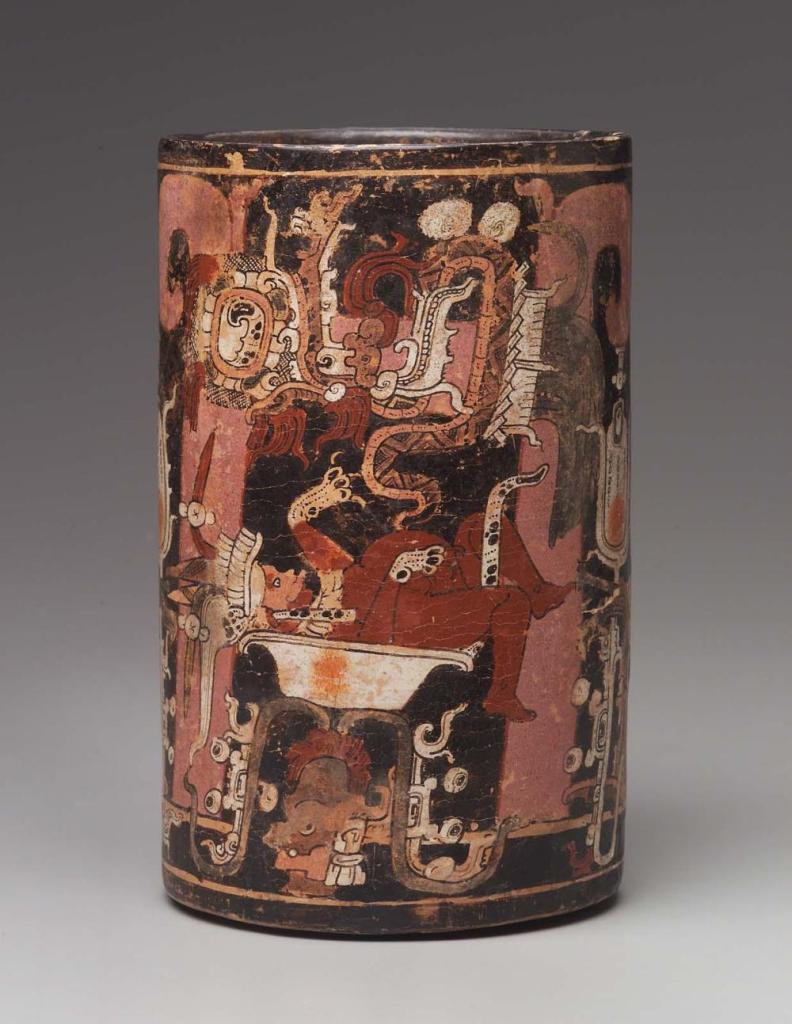

This one was absolutely fascinating to me! Here is the description by the museum’s website:
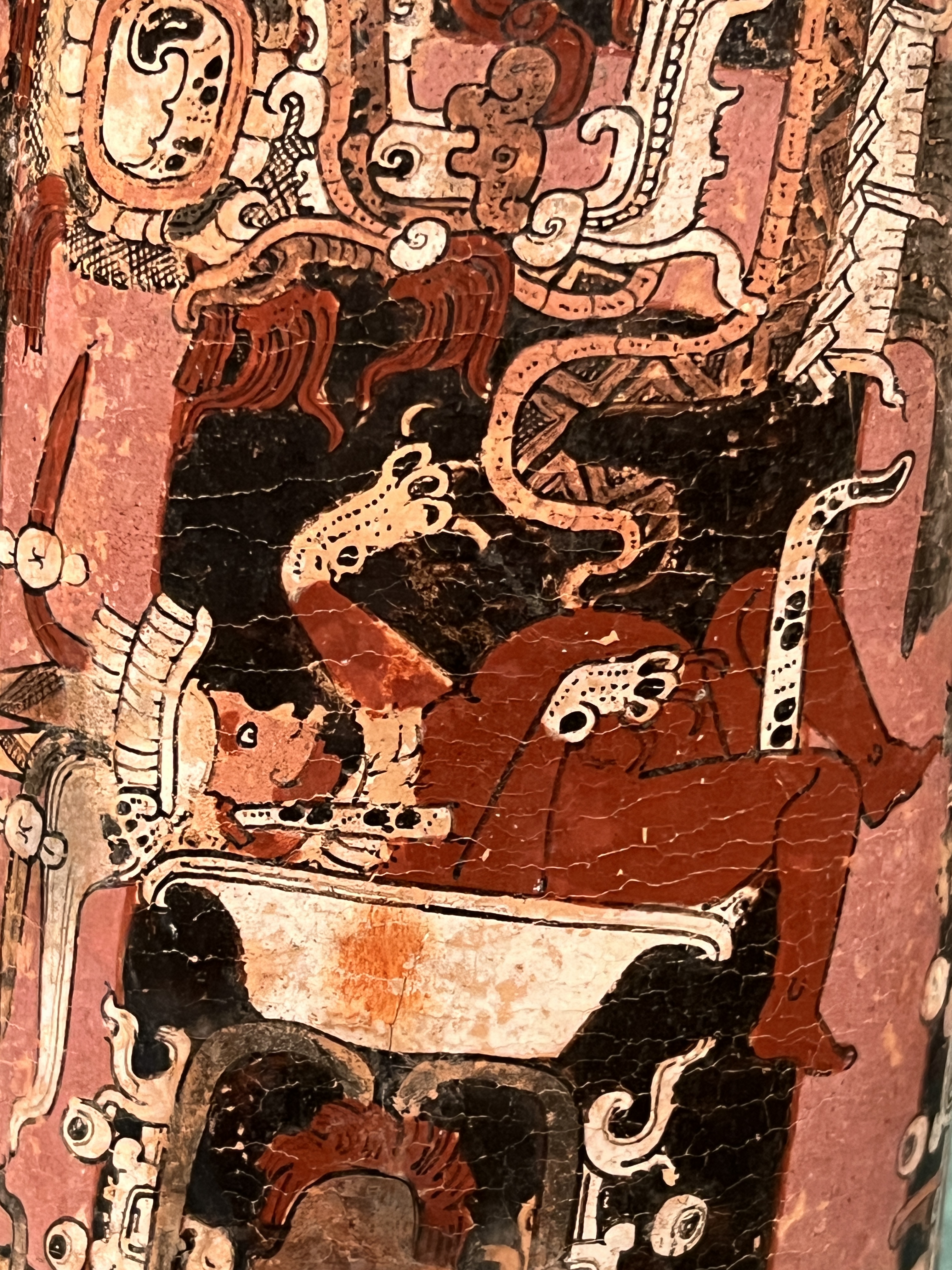
The scene renders the birth of the Baby Jaguar deity, who lies in a dish with a “birth serpent” umbilicus rising from his body. The individuals beside him likely are his parents. Maize plants and heads suggesting serpents or dragons adorned with water lilies indicate the supernatural mountain location of this deity’s birth.
Ritual drinking vase depicting the birth of a supernatural nicknamed “Baby Jaguar”, who lies in a dish with a “birth serpent” umbilicus rising from his body, and flanked by his divine parents. Two open-mouthed serpent heads, which sprout white maize leaves and bracket the reclining baby, denote the numinous location of his birth, named sak witz “white mountain” in the vase’s hieroglyphic text. The black background indicates primordial time before the creation of humanity, and the text records the birth’s mythical date (1 Ix 2 Muwaan) and the Baby Jaguar’s name (Huk Yeh Tok’, “Seven Edges of Flint”). Large flint blades adorn his and his mother’s headdresses. One of three vases painted by the same master artist.
I took photo of details that I loved:


I just love the pose of that baby jaguar with those paws! Ans so much symbolism and mysticism!
3. Cylinder foretelling the death of ruler. I could not find this vase in the gallery but they had a great explanation on the screen:
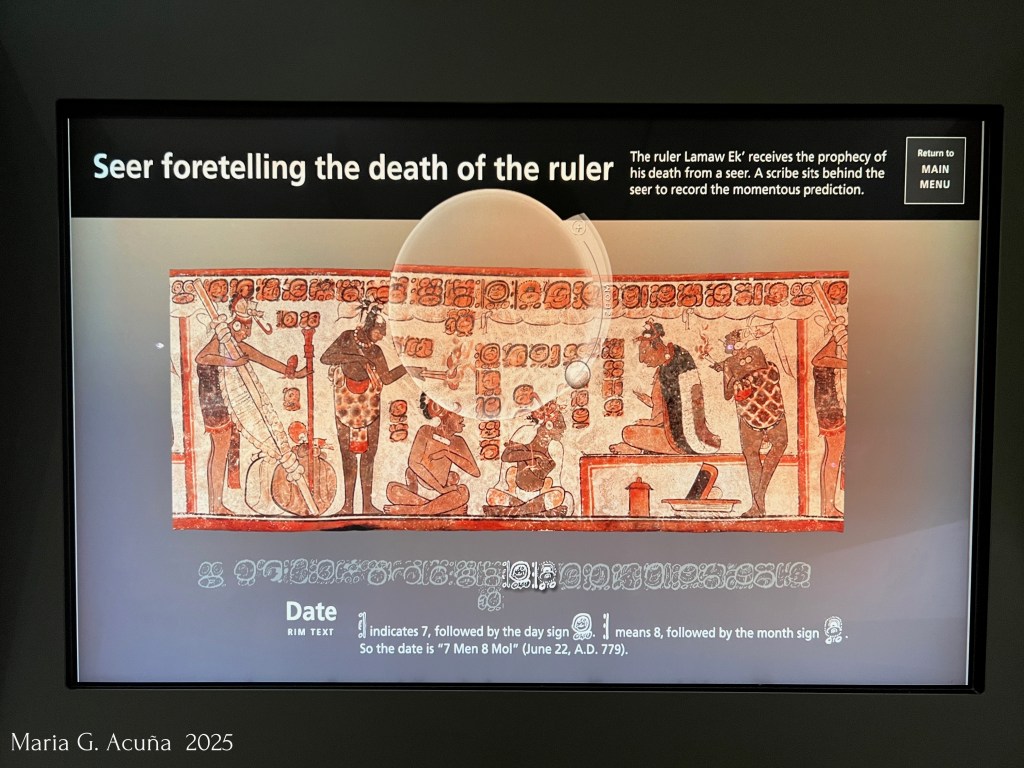
I loved how it translated some of the Maya hieroglyphs.
There were many other vases but this post is getting a little long. I will show the photos and if you are interested in reading more about them visit HERE and make sure you use this filter: Location(s): Gallery LG32 (Ancient Mesoamerica).


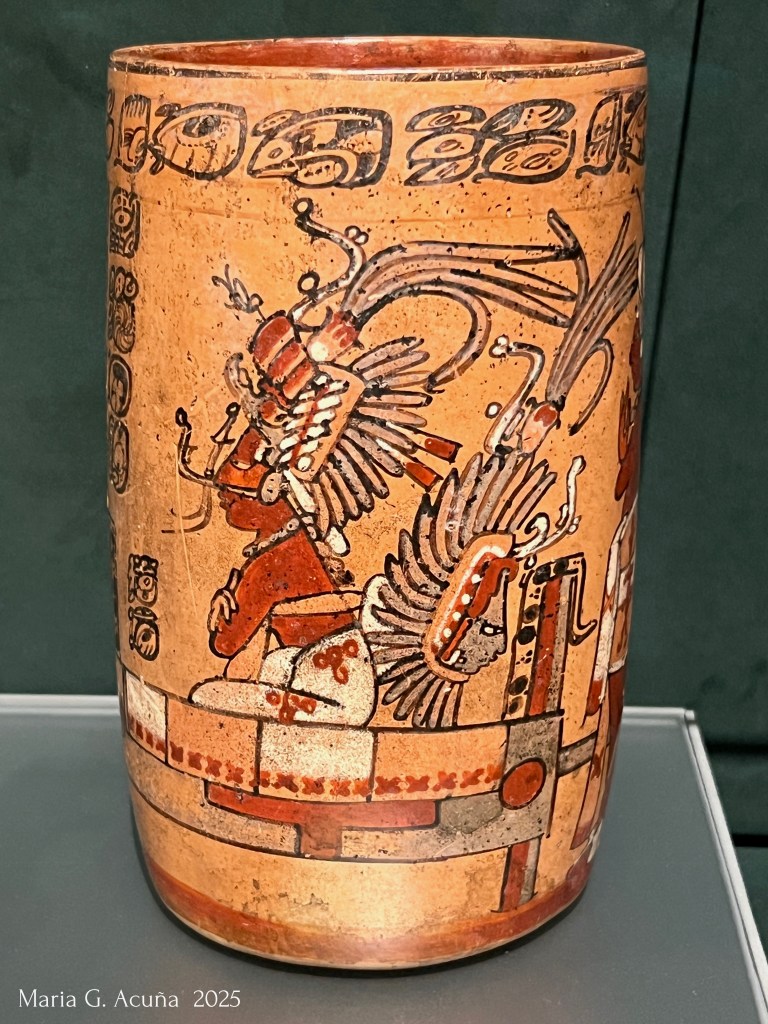


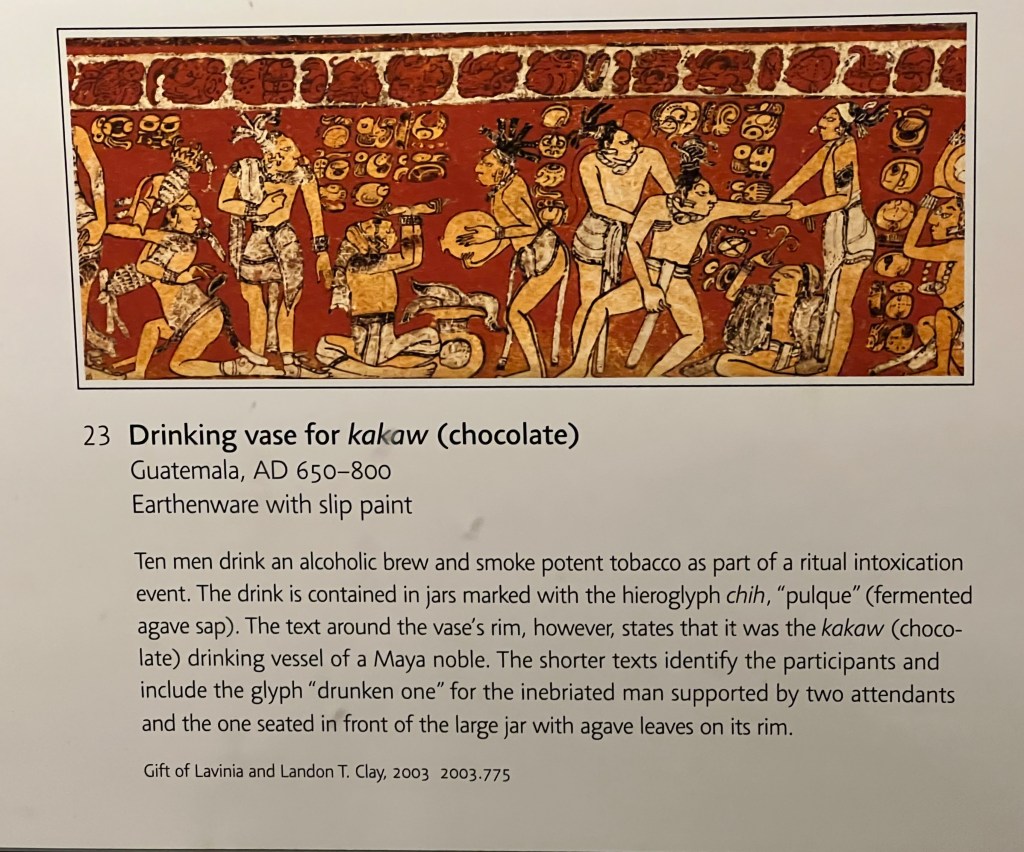
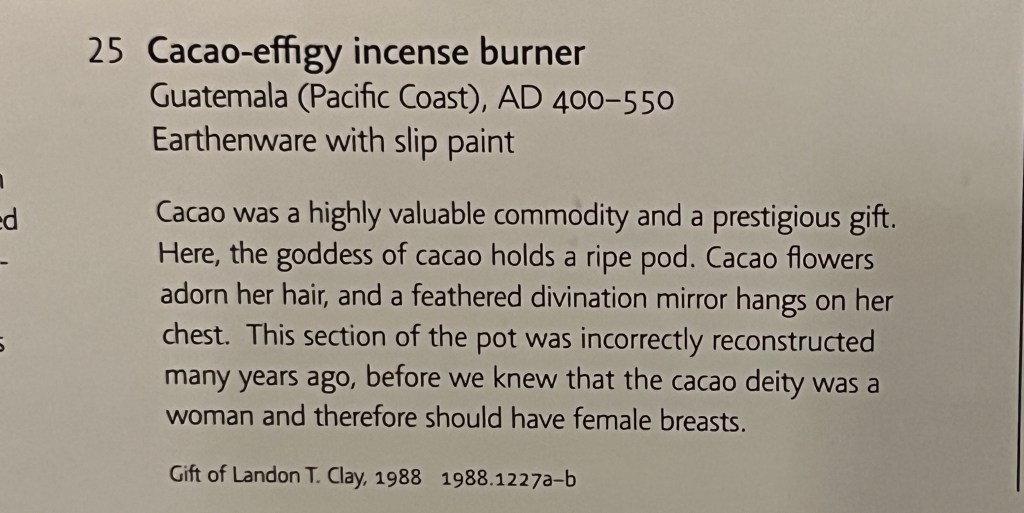
Yeah, I’ve see that guy that can’t get up in current times and it is not very different! These Maya people knew how to party! And while we are on kakaw, cacao look at this beauty:

The last piece I will showcase from the MFA is a plate. I was so impressed by its detail… and sophistication!

Object Place: Department of Petén, Guatemala, Naranjo-Holmul area
This rare plate portrays the Maize god dancing at Three-Stone-Place. The white cups symbolize the three stones, and the hearth’s creative fire is rendered as a red circle on the underside of the plate.

Large plate with three tall, cylindrical supports (“legs”), each containing a rattle sphere of clay. Painted in the Holmul-style of eastern Guatemala, the image features the Maize god dancing at creation when he set the Three Stones of the cosmic hearth. These stones also are represented by the three attached cup-like forms on the interior of the plate as well as by the legs, painted in a striped black-and-white pattern that symbolizes stone among such Mesoamerican cultures as the Mixtec of Oaxaca. The Maize god dances on an area painted in a cross-hatched motif with fire curls which may portray the fire of creation in the darkness of the pre-creation era. The exterior walls of the plate echo this theme, being decorated with the black-painted waters of the antedeluvian sea and waterlilies.
The bottom of the plate is painted with a red circle at its center, which depicts the fire of the cosmic hearth of creation. The long hieroglyphic text eludes full decipherment, but it includes the local version of the Primary Standard sequence, a dedicatory phrase, and may name a male member of the Holmul nobility.
Well this completes part one of our exhibit visit… more to come soon!
If you are ever in Boston do not miss seeing the Museum of Fine Arts. They have made huge efforts to include art from the americas and the world!
 My Virtual World Trip
Hola Ma. Gabriela
Excelente reportaje de la cerámica y pintura Maya.
Tanto el aspecto técnico, simbólico/religioso como creativo muy bien explicado en la abundante colección del MFA de Boston.
Felicitaciones
LikeLike